The Calgary Interfaith Council was invited to host an Interfaith Service for the opening of the G7 Jubilee Peoples Forum in June 2025. It was a pleasure to craft the service and consider how to create a shared expression:
- Being attentive to the multiple themes of justice, equity, compassion, generosity, interconnectedness and impermanence
- Honouring the ways we speak of the Divine or reference diverse lineages – God, Creator, Mother Earth, Spirit, Jesus, Muhammad, Bahá’u’lláh, Buddha
- Accessing various texts – Torah, the Bible, the Quran
- Speaking in diverse languages – Hebrew, Arabic, English, Sanskrit
- Using the words of leaders – Rabbis, Reverends, Priest, Imams, Cardinals, faithful men and women.
- Sounding a variety of vibrations – human voices, piano, harmonium, shofar
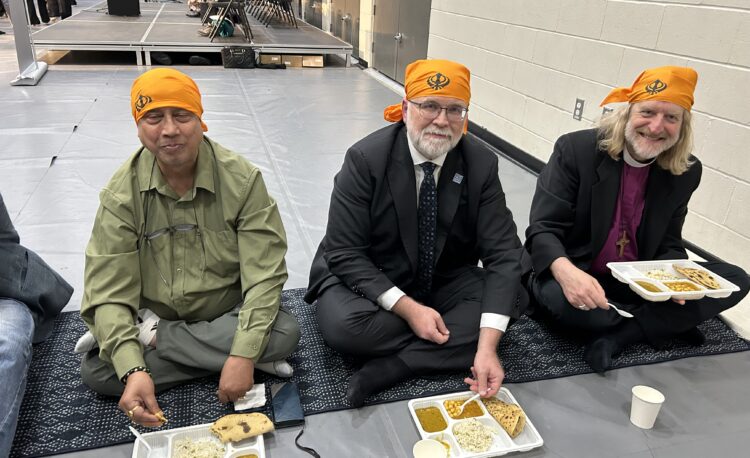
The service was followed by Lungar, a free meal that is part of the Sikh tradition based on the wisdom that feeding people’s bodies comes before feeding their souls. It was hosted by the Dashmesh Cultural Centre. Before the service started, 26 men in different coloured turbans arrived in two vans with five gigantic pots filled with rice, dahl, and chickpeas. They brought multiple shiny metal buckets with handles, as well as bowls and serving spoons. They rolled out runner rugs and brought bags of head coverings.
When the service was over, our Sikh hosts invited us to take off our shoes, put them under the theatre-style seats, move to where the rugs were rolled out in long rows, and take a seat on the ground. In a very organic fashion, 30 volunteers moved up and down the rows pouring water over stainless steel bowls for hand washing and providing towels to dry hands. Then the volunteers delivered the food. They ladled chickpeas, dahl, and rice from the buckets to the plates, which were divided into sections for each dish.
This sacred meal was a wonderful embodiment of the message of Jubilee: we are all equal. We all sat on the floor. We acknowledged the sacredness of the moment by taking off our shoes and washing our hands. It was “gracefull.” We received the gift of food brought to us without cost. We were blessed by the generosity and service of the Sikh community. There was conversation, laughter, and big smiles !
As the Peoples Forum continued, a number of people commented on the power of the service and the Lungar meal. I asked Joy, who mentioned how much she had enjoyed it, what was particularly meaningful. She said it wasn’t so much what was said as the diversity of voices, readings, and songs. It was the actual variety of sounds. As we chatted, both of us from the Christian traditions, our imaginations were drawn to the story of Pentecost, which had been celebrated in churches all over the world the previous Sunday.
Pentecost refers to the events after Jesus’ death, resurrection, and ascension into heaven, when his followers were gathered together in Jerusalem. The Holy Spirit came upon them and they proceeded to share the wonders of God in diverse tongues. At the People’s Forum interfaith service, the wonders of God were shared in diverse languages.
In Jesus’ time, the events of Pentecost were followed by the creation of a new community, one founded on generosity, sharing, and radical inclusion. Against all traditions and processes of purity, Jews and Gentiles came together, ate together, shared resources, and created a community of kindness and care. It felt as if the Lungar meal was an echo of that energy.
The theme of Pentecost started to emerge from the People’s Forum. I ended up speaking with Tarek Al-Zoughbi, a special guest from Gaza. I had assumed he was Muslim. It was only after his official introduction that I realized he was a Palestinian Christian. When I asked him about the history of Palestinian Christians, he explained that they trace their origins to Pentecost.
That was wild!
As I shared these emergences with others, we noticed further synergies. During the service, the noise of the rain and the wind outside was so loud that at one point we could hear it on the roof and feel it in the building. The Anglican Bishop commented that it was like the winds of Pentecost.
Within the Christian tradition, there is a clear pattern: when God is trying to get your attention, a question or invitation is repeated. So after Pentecost had come up three times, I considered the connection between the People’s Forum interfaith service, the Lungar celebration, and Pentecost. How do they speak to each other?
Is there some way in which interfaith collaboration and community – in service, in wonder and in meaning-making – is an echo of Pentecost, an expression of radical welcome and inclusive community?
As I rested in this invitation and shared it with others, further ripples of insight and meaning occurred. My poet friend suggested that part of what was happening was a recognition of, a resonance in, and a reveling in love. That was what was being shared. The intention behind the sharing was the openness and the love with which each person had come.
Though they came from different lineages and traditions, the participants had come with the shared intention to be respectful of others and to offer what they know about the meaning of life, the power of love, and the nature of God.
In the sweetness of that, we find ourselves on common ground – with the same needs, the same longings.
In the sweetness of that we find ourselves to be neighbours with diverse lineages, hundreds and thousands of years old.
Lineages that honour life, hold death, celebrate emergence and possibility.
Lineages that support us in the tender, beautiful frailty of being human alone and connected, in family, in church, temple, gurdwara and sangha, in community and in culture, with all beings rooted and winged with legs or fins, all of it expressions of the living Earth and the generative and generous Cosmos.