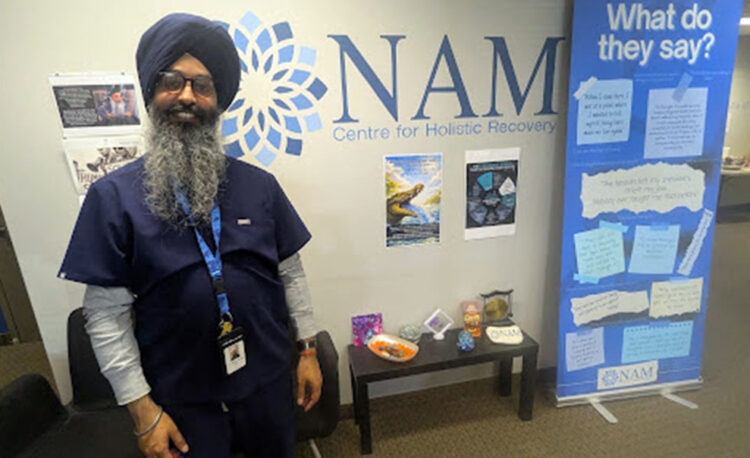
“Holistic recovery for all” is the mission Dr. Harbir Gill strives for at the Northeast Addictions and Mental Health Centre (NAM), an addiction treatment centre he founded to serve Calgary’s diverse communities. We spoke to Dr. Gill about the experiences which led him into addiction medicine and the unique approach NAM has pioneered to address addiction through the mind, body, family, community, and spirit.
Dr. Gill’s journey into addiction treatment began while working as a family doctor and seeing the consequences of untreated addiction in Calgary’s Peter Lougheed Hospital. He was particularly struck by the number of Punjabi-speaking and other South Asian patients with substance use issues cycling through emergency care and not availing themselves of other detox and addiction treatment programs. “I thought to myself, how can I be helpful?” he recalled. That question led him to focus his practice in addiction medicine and found NAM.
He quickly discovered that simply translating conventional treatment was insufficient. “I can’t just translate everything I know in English, into Punjabi ,” he said. He described to us how addiction treatment has cultural, religious, spiritual, and psychological dimensions which needed to be understood together. As NAM’s programme developed, its approach became increasingly holistic and accessible to people who might struggle with English-language therapy.
Today, NAM offers what Dr. Gill describes as a “continuum of care.” Some clients attend weekly groups or receive individual medical stabilization and therapy, while others participate in day programming. Those requiring greater support can enter its inpatient programme, where NAM provides housing, meals, structure, and an environment in which people can develop healthier lifestyles. “You need safety,” Dr. Gill told us, describing physical, emotional, financial, and relational security as essential to allowing healing to even begin.
Dr. Gill relayed that families and communities are equally important. “Family structure can make or break treatment,” he explained. NAM, therefore, seeks to strengthen the relationships to which its clients belong, rather than treating them in isolation. Its approach focuses on what Dr. Gill calls three core relationships: “relationship to self, relationship to other, and the relationship to one’s higher power.”
That final relationship shows how spirituality a central part of NAM’s work, but not one confined to a particular religion. Dr. Gill explained that a higher power might be Jesus, the Gurus, Allah, or the Buddha, depending on the client, while others may approach the idea without reference to organized religion. NAM’s prayer room accordingly contains Christian, Sikh, Islamic, and other spiritual texts. “We’re not a place of worship,” Dr. Gill emphasized, but the centre is often somewhere people begin reconnecting with a higher power.
For Dr. Gill, this is also where NAM’s work becomes distinctly interfaith. “The true interfaith is when we can derive support and connect” rather than simply accepting that different people practise religion differently. He encourages people in recovery to rediscover their own “roots” by returning to a church, another faith community, or an Indigenous ceremony, and to recognize the sources of healing already present in their communities and experiences.
It is this philosophy which also draws Dr. Gill to the Calgary Interfaith Council. He admires CIC’s ability to bring different cultures and faiths together even through difficult moments, describing the work of “holding space” across profound disagreements as both difficult and necessary. “We’re a community of diversity,” he told us. He highlighted the importance of conversation to avoid siloing into separated communities. For NAM, recovery similarly depends upon rejecting that isolation by reconnecting people with themselves, their families, their communities, and whatever source of spiritual meaning they have in their tradition.