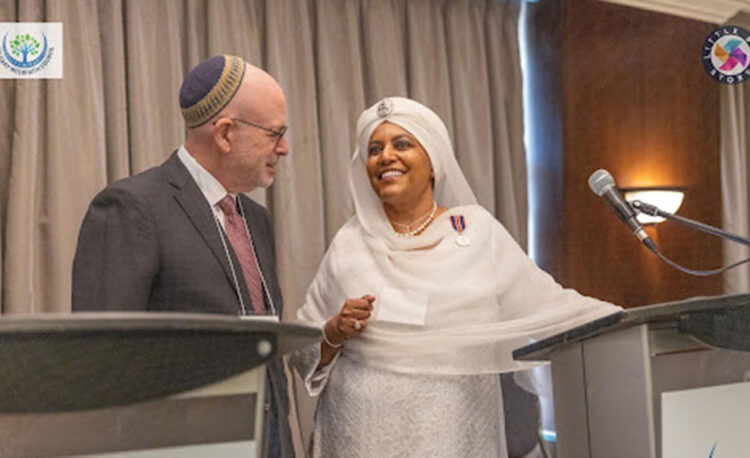
Interfaith work has been part of Dr. Harjot Singh’s life since her childhood. She recalled to us how her interfaith journey “started with teaching my teachers in elementary school what a Sikh does, why a Sikh doesn’t eat meat, and why we wear turbans.” Since that time, Dr. Singh has become a pillar of the Calgary Interfaith Council, including through her commitment while serving as board chairperson.
When we asked Dr. Singh about how she became connected with CIC and interfaith organizations in Calgary, she shared her recollection of monthly interfaith prayer services held at the Devonian Gardens following the 9/11 terrorist attacks. At the same time, Dr. Singh began working with a group of interfaith women to recognize the divine feminine of each faith. Her involvement with CIC began after being approached by Rabbi Shaul Osachey, one of the founders of CIC.
Despite her work as chair of the Calgary Foothills Primary Care Network at the time, Dr. Singh always made sure to be involved in the opening ceremony for CIC’s UN World Interfaith Harmony Week. “What I cherish the most is when we come together and offer prayer on an interfaith basis,” she explained, “the vibratory resonance of hearing prayers in their own scriptures, in their own language […] is so beautiful.”
Within months of becoming chair of CIC’s board, Dr. Singh told us, the organization was faced with the tremendous challenge of navigating the aftermath of the October 7 terrorist attacks and the Gaza War. She recounted her realization of the need to “build some bridges of discussion and dialogue, even though there was going to be emotion and disagreement.” “If you can’t see the God in all, you can’t see God at all,” Dr. Singh told us. She recalled how, during CIC’s G7 events, the executive director of Jubilee USA told her, “I can’t believe your interfaith council is still together, given the politics of the Gaza War and the terrorist attacks.”
Though Dr. Singh is stepping down as chair of the board, she told us that she will remain as a member of the board. In addition, she also chairs the Spiritual Care Advisory Committee for Acute Care Alberta. “Wherever there is a place to educate about Sikhism–but also wherever there is a place to educate about any faith–I make it a priority,” she told us.
Going forward, Dr. Singh is hopeful that the Sikh community continues to reach out and grow past its insular tendencies. “All faith communities need to be proud in their tradition,” she shared with us. She also shared her hope that the medical profession will treat the spiritual elements of healing with more respect and consideration. “Some of my patients don’t belong to a particular faith, but they will resonate with a certain practice, and so sometimes I teach them how to meditate in their own faith,” Dr. Singh told us, sharing the positive effects her patients have expressed from this guidance.
Dr. Singh is convinced of the importance of interfaith work and its centrality in her own faith as a Sikh. “It has been a journey of exploring what Guru Nanak originally did when he started Sikhism,” she explained. “He travelled with a Muslim and travelled with a Hindu, and he taught about the oneness of humankind.” Of her work in CIC, Dr. Singh said, “it’s really practicing what my Guru taught me.”