“Religion is more than just a set of customs and beliefs.”
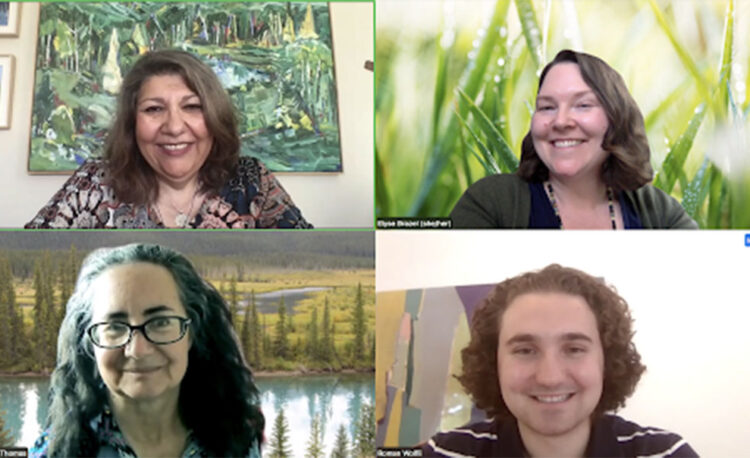
According to our enlightening discussion with May Cummings and Eva Torn Thomas of the Calgary Baháʼí community, faith is ultimately about transforming ourselves so that we can “better society.” We spoke to May and Eva about their recollections on the history of the Calgary Interfaith Council and their hopes for building stronger relationships between Calgarians of different religious backgrounds.
Eva’s involvement in Calgary’s interfaith community predates CIC itself. She recalled attending gatherings at different places of worship and joining an informal network of people interested in interfaith dialogue. At the time, she relayed, various groups focused on dialogue between particular faiths, but some began envisioning an organization that could gather everyone “under one roof.” Eva watched these efforts develop into CIC and participated in its inaugural UN Interfaith Harmony Week, which received international recognition with an award from the King of Jordan.
May joined this work after moving to Calgary in 2017. Having previously taught a World Religions course in Saskatoon, she was naturally drawn to interfaith endeavours as a way to find community in Calgary. Over the years, she has watched CIC expand from Interfaith Harmony Week to the Interfaith Breakfast, Tables of Wisdom, and Women of Faith. Through this work, she hopes people can come to understand that “the essence of religion is love and unity and fellowship” and find “a common path to work together.”
For both of them, the relationships created through CIC are at the heart of its work. Eva values being able to sit around a table with people of different traditions and approach them with humility as someone wanting to learn. May agreed that this spirit is “the core of everything,” hoping that, as CIC grows, it retains its emphasis on learning and understanding.
These principles also reflect what is currently alive within Calgary’s Baháʼí community. Eva described a longstanding Baháʼí emphasis on “developing community in our neighbourhoods.” Rather than addressing prejudice only through institutions or prominent leaders, she sees grassroots relationships as essential to building communities capable of overcoming divisions. May hopes to extend this work among children and youth in particular. She envisions young people from different faith communities meeting one another and discussing “their faith and how they live their lives according to their faith.” For May, learning about another religion is most meaningful when it is personal and concrete. “I have to meet people and make my own experiences,” she told us.
Education similarly figures prominently in Eva’s hopes for the future. She would like opportunities to learn about different religions to become more central in schools and elsewhere. Beyond education, however, her central hope is that people of other faiths associate with each other in a spirit of fellowship at every level of society. For May, the importance of this work becomes clearest when thinking about future generations. “In 30 years, I’m not going to be around, but these children and youth are,” she told us. By creating opportunities for young people to encounter differences with curiosity rather than fear, Eva and May hope to build enduring communities rooted in the Baháʼí conviction that religion is a source, not of division, but of love, unity, and respect for one another.