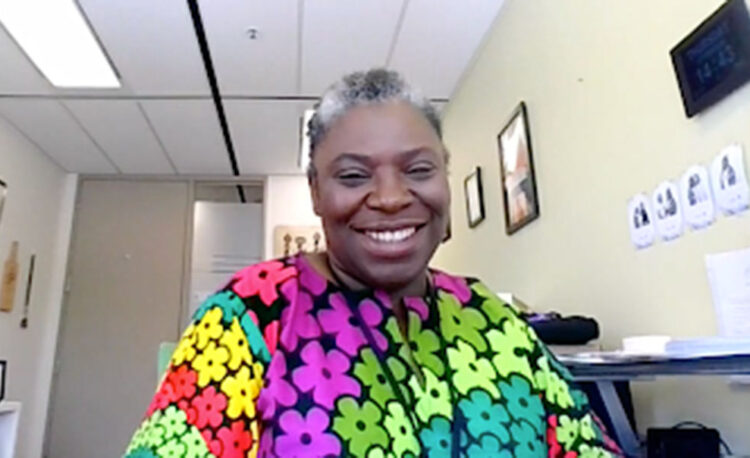
“Restoring people’s faith and hope is probably my biggest calling,” Dee Adekugbe told us about the philosophy underlying her work with Ruth’s House Society. We spoke to Adekugbe, a Calgary pastor and the founder and executive director of Ruth’s House, about her work supporting Black women and families affected by domestic violence and her aspiration to build a community capable of providing that support across religious boundaries.
Ruth’s House provides emergency shelter and transitional housing for women and children affected by domestic violence, alongside Mandela House for men. Adekugbe described its broader purpose as helping to “heal and restore people” and move from toxic relationships towards healthy ones.
For Adekugbe, however, responding to domestic violence requires more than providing physical safety. “Our beliefs, our values—they determine the decisions that we make and the outcomes of our lives,” she explained. Ruth’s House therefore seeks to provide spiritual, emotional and mental safety as well as physical support. Central to this vision is creating a space where people can receive help “without being judged,” while having their individual beliefs and values respected and incorporated into the support they receive.
Faith can be particularly important when people are experiencing the darkest periods of their lives. Adekugbe noted that tragedy can lead people either to cling more closely to their faith or to lose touch with it. For those who have lost faith, Adekugbe asks, “How do I help you reconnect with your faith so that it can help you through that time?” This includes both faith in a higher power and “faith in humanity,” which provides the hope necessary to emerge from dark periods of life.
Looking forward, Adekugbe hopes to significantly expand this work. Among her goals are more affordable housing for low-income people and expanded mental health and spiritual supports tailored to people’s particular needs and beliefs. Ultimately, she wants to discover “how far we can go with this, and how many lives we can touch,” reaching people “across all faiths and across all beliefs.”
Adekugbe told us that achieving her goals takes a village. Ruth’s House already works with Christian, Muslim, and Hindu communities so that clients seeking spiritual support can be connected with people from their own tradition. Membership in CIC offers an opportunity to expand this further, unlocking a network of faith practitioners across Calgary’s diversity.
Adekugbe discussed the difference between the important but distinct roles of a “network” and a “village” in her work. “A network is outside,” she told us, while “your village is consistent.” Her hope is therefore to develop relationships that go beyond a simple contact in a phone. Speaking of the need for faith communities to work together to address domestic violence, Adekugbe explained that “a collective group can have a bigger impact.” For Adekugbe, people united by a common purpose are ultimately more valuable than even financial contributions.
Adekugbe’s ultimate aspiration is a community in which people affected by domestic violence have both the freedom to seek help and have those supports accessible. She highlighted the barrier posed by people’s worry about how their leaders or communities will respond. Building community, she believes, would create a ripple effect of “education, awareness, and prevention.” “I believe in the impossible,” Adekugbe told us. “I have always believed that anything can happen if people believe and if people are willing to work towards it.” It is this belief that inspires her continued efforts to bring hope to people in the darkest places.