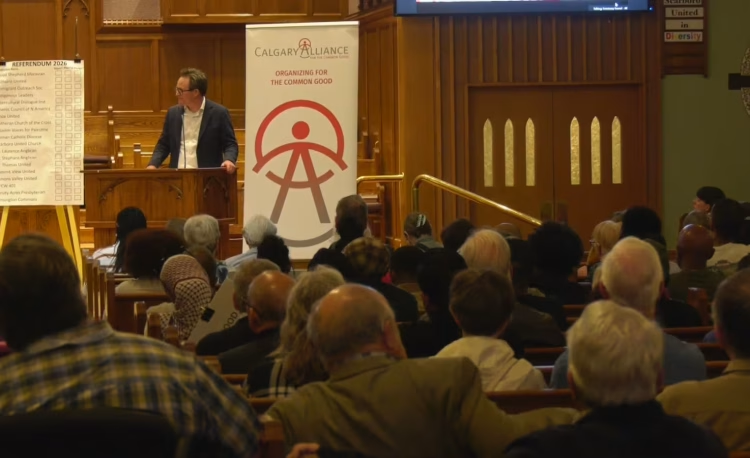
“We live in a unique time. Religions that once responded to each other with violence now have leaders sitting down saying, ‘How do we build trust? How can we learn from each other? How can we work together?’” Ryan Andersen reminisced to us about the goodness he has seen in Calgary’s interfaith community. We spoke to Andersen, who is a Lutheran pastor and currently leads the Calgary Alliance for the Common Good, about the foundation of the Calgary Interfaith Council and the current work of the CACG.
Andersen recalled the CIC growing out of the faith leaders caucus of the CACG, then the Metro Alliance for the Common Good. Its original impetus was fighting poverty and the belief that faith communities had an important role to play in public life. From these beginnings, Andersen has watched the CIC develop into the space focused on “relationship building, dialogue, [and] education” that it is today.
For Andersen, the CIC’s greatest accomplishment has been the relationships it has fostered. “It’s the relationships that count,” he told us. In a political climate that he believes increasingly tries to create division between people, Andersen sees particular significance in faith communities finding common ground amongst their differences and celebrates the success the CIC has had doing this in Calgary.
That concern with the role of faith in public life has become especially important to Andersen as he turns his attention to the referendum coming this October. He described the political moment surrounding the referendum as one in which people are being asked to trade “responsibility and wisdom for scapegoating and taking advantage of the most vulnerable.” For Andersen, faith communities have an important role in responding to this. “You can choose love, or you can choose hatred,” Andersen told us.
Recalling the recurring scriptural injunction to “be not afraid,” Andersen argued that religious leaders should not allow fear of controversy to prevent them from addressing difficult questions around the referendum. “Wake up,” he urged them. “That’s your job as a faith leader. Be awake for us. Help us see reality as it is, and don’t be afraid.”
This conviction is already shaping his work with the CACG. Andersen told us about plans for an interfaith leaders lunch focused on “the role and struggles of faith leaders meeting this moment around the referendum.” He is also encouraging faith leaders to write op-eds and potentially make videos. Ultimately, he wants to see “faith leaders in public expanding people’s imaginations” about the values that matter and how they apply to the present moment. “If you’re a faith leader, you are a public person,” he told us. “It means you have public responsibilities.”
For Andersen, however, these concerns ultimately point to something much broader. “As I get older, what I realize more and more is that we have forgotten what it means to be human,” he reflected. Different religious traditions, he believes, offer resources for rediscovering humanity’s responsibility to care for the world and for one another. Andersen told us that faith communities can offer courage and curiosity.
Reflecting at the end of our conversation, Andersen expressed his joy at seeing a new generation beginning to take up interfaith work. “I think we’re at the beginning of an important time for humanity that will take generations to journey through,” he told us. For Andersen, there is something deeply hopeful in having helped create something and then seeing it “carried by other people.”