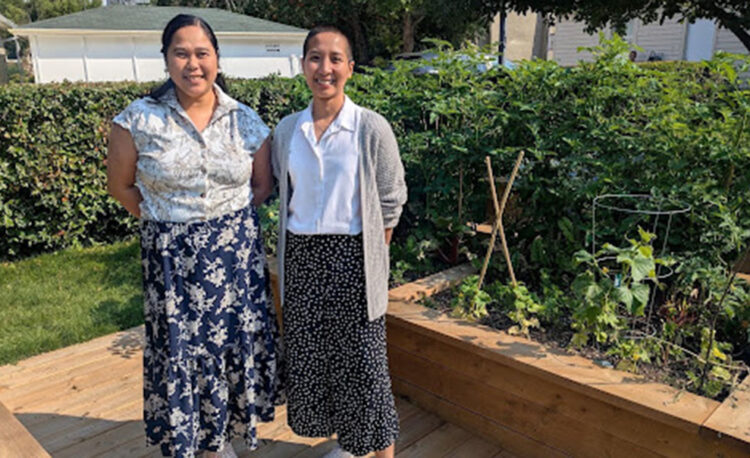
“It starts with you,” said Whitney Nagasan and Pristine Laroza of the work of the FCJ Christian Life Centre. The Centre is rooted in the belief that meaningful change begins with individuals and grows through community. We spoke to them about their environmental, spiritual and wellness programmes and their hope that it can increasingly become a place where Calgarians come together to learn, rest, and care for one another.
One initiative particularly exciting them is the Centre’s celebration of the Season of Creation. Inspired by Pope Francis’s Laudato Si’ (Praise Be), this year’s programming brings together organizations and speakers to explore composting, energy efficiency, Calgary’s watershed and the sacredness of water. Rather than dwelling on the “doom and gloom” surrounding environmental issues, Nagasan hopes to foster “environmental hope and conversion,” reminding participants that many small contributions can together create meaningful change.
Laroza sees this work as particularly valuable when it reaches families and children. “All these initiatives, they don’t really move the needle if we don’t do it at home,” she explained. Through the Centre’s Vacation Bible School and school outreach, children are encouraged to find God “in creation, in themselves or in others,” while learning practical ways to care for the environment. “You can do something,” Laroza emphasized. “It doesn’t have to be big.”
The Centre’s mission exists in various other domains as well. Its Well Care programme provides gardening, yoga and other activities for seniors, helping to combat loneliness while fostering new friendships. Nagasan described how watching participants return outside scheduled programmes simply to water the garden and spend time together, showing how the garden became a place of connection, belonging, and community. “Our mission here at the Centre is to strive to be a Centre of hospitality and hope where God can be experienced in a changing world,” she told us. She shared that she hopes that the Centre will serve as a home for people and provide a source for hope.
Looking forward, Nagasan and Laroza hope to draw more people into this community. Alongside its existing programming, the Centre offers spiritual direction across different faith traditions and private retreats intended to provide “rest, restoration, and healing.” Nagasan hopes these retreats can help rebuild “that culture of going back to slowness,” giving people permission to unplug from the pressures of everyday life.
Laroza highlighted that realizing the Centre’s potential will require greater collaboration. “We can’t do it alone,” she told us. Rather than recreating work already being done elsewhere, Nagasan hopes the Centre can provide a space where other organizations bring their expertise to new audiences. “They’re already doing the job that we would like to promote,” she explained. “Why not bring them here?”
Their hopes for the Centre can perhaps be summarized by Nagasan “three V’s”: “visibility, viability, and vitality.” Greater visibility can bring more people through the centre’s doors, financial viability can sustain its programmes, and vitality can allow the community forming around them to flourish. Laroza’s invitation is simple: “Get involved.” She believes everyone has something to contribute “regardless of age, regardless of background.”
Ultimately, Nagasan describes the Centre’s work through the Ignatian principle of cura personalis, or “care for the whole person”: body, mind and spirit. Through wellness, spiritual growth, rest, and community, she hopes the Centre can provide people with that care while empowering them to extend it to others. “When you are a better person, you are a better contributor and community member,” she told us. From there comes a better community and, ultimately, “a better world to live in.”